
XChat – Private Tor Instant Messenger
Private messaging over the Tor network
A lightweight, open-source instant messenger built for direct peer-to-peer communication through Tor hidden services. No phone number, no social graph, no surveillance-first design.
Explore the project on GitHub: Open the XChat repository
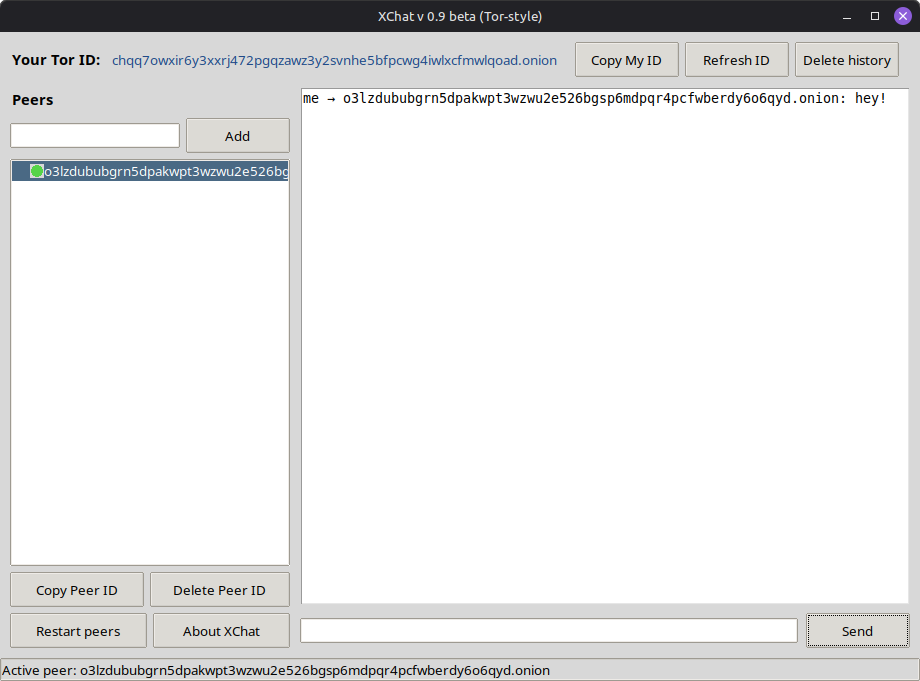
XChat is a lightweight, open-source instant messenger built for people who want direct, private communication without relying on mainstream platforms, centralized servers, phone numbers, or invasive tracking.
Inspired by the simplicity of older peer-to-peer messengers and the privacy philosophy behind Tor-based communication, XChat is designed to provide a minimal, focused, and censorship-resistant chat experience.
Instead of connecting users through large commercial messaging networks, XChat uses Tor hidden services (.onion addresses) to enable direct peer-to-peer messaging through the Tor network. Your identity is represented by a Tor ID, not by a phone number, email address, or social media profile.
Whether you care about privacy, anonymity, self-hosted style communication, or simply want a messenger that does not treat you like a product, XChat offers a different path.
Based on the repository README, XChat currently includes persistent Tor identities, peer-to-peer text chat over .onion addresses, a classic split-pane interface, saved peer lists, an offline message queue, and a local history wipe function. It is written in Python 3 and designed to launch and manage its own private Tor process by default. (GitHub)
Why XChat exists
Modern messaging apps often demand too much:
- your phone number
- your personal contacts
- your metadata
- your device ecosystem
- your trust in centralized infrastructure
Many “private” chat platforms still depend on central servers, account recovery systems, cloud routing, analytics, push notification ecosystems, and platform lock-in.
XChat is built around a simpler idea:
You should be able to talk privately without handing over your digital identity.
With XChat, communication is centered around Tor-based peer identity, not surveillance-friendly account systems.
No social graph.
No algorithm.
No feed.
No engagement farming.
No corporate profiling.
Just private chat over Tor.
Core philosophy
1. Privacy by architecture
XChat is not trying to “add privacy later” as a marketing feature. It is built around Tor-based networking from the beginning.
2. Minimalism over bloat
No noisy dashboards, no addictive features, no pointless complexity. XChat is meant to stay focused on messaging.
3. Independence from Big Tech ecosystems
No dependence on phone verification, centralized identity providers, or social media infrastructure.
4. Open source and transparent
XChat is a project that can be inspected, improved, audited, forked, and built upon by the community.
5. User-controlled identity
Your Tor identity belongs to you. XChat supports a persistent onion identity, while also allowing you to refresh it when needed. (GitHub)
Key features
Tor-native peer-to-peer messaging
XChat uses Tor hidden services for incoming connections and Tor SOCKS for outgoing communication, enabling direct private chat through the Tor network.
Persistent Tor ID
Your XChat identity remains stable between launches unless you choose to change it. This gives you continuity without requiring a traditional account system.
Classic messenger interface
XChat keeps the interface simple and practical, with a split-pane layout inspired by older messaging tools. It is built for function, not distraction.
Saved contacts / peer list
Peers can be stored locally so you do not need to manually re-enter onion IDs every time you restart the application.
Offline message queue
If a peer is offline, messages are queued and delivered automatically when they come back online.
Local history wipe
XChat includes a Delete history function that removes local conversation history and cached/offline messages from disk.
Private Tor process
By default, XChat launches and manages its own private Tor process, meaning it does not require a separate system-wide Tor service to already be running.
Linux-friendly and open
XChat is built with Python 3.9+ and includes packaging support for Debian-based systems. (GitHub)
Who XChat is for
XChat is made for people who value:
- private communication
- anonymous or pseudonymous messaging
- anti-censorship tools
- decentralized thinking
- Tor-based communication
- open-source software
- lightweight Linux-friendly applications
- communication outside mainstream app ecosystems
It can be useful for:
- privacy-conscious users
- activists
- journalists
- researchers
- whistleblower-friendly workflows
- open-source enthusiasts
- Linux users
- people who simply want a quieter and more independent messaging experience
What makes XChat different
Most modern messengers are built around platform ownership.
XChat is built around user autonomy.
That means:
- no phone number required
- no social media account required
- no cloud identity lock-in
- no centralized friend graph
- no ad-tech logic
- no surveillance-first design
XChat is not trying to become another bloated messenger super-app.
It is trying to remain something much more valuable:
A simple private tool that does one thing well.
Designed for a different kind of internet
The internet used to feel more open, experimental, and independent.
Today, much of online communication has been absorbed into a handful of platforms that monitor, rank, filter, monetize, and shape how people interact.
XChat belongs to a different tradition — one where communication is:
- more direct
- less manipulated
- less commercial
- more user-controlled
- more resilient
It is for people who still believe software should serve the user, not the advertiser, not the platform owner, and not the data broker.
Open source project
XChat is an open-source Tor messenger project hosted on GitHub and intended to be transparent, hackable, and community-friendly.
If you support:
- privacy software
- censorship-resistant communication
- peer-to-peer tools
- Linux/open-source development
- independent messaging infrastructure
…you are welcome to explore the code, test the app, suggest improvements, report bugs, and contribute.
Project repository: View XChat on GitHub
Download, test, contribute
XChat is being built for users who want a simpler, more private way to communicate.
If that matters to you, try it, inspect it, improve it, and help shape it.
Explore the project on GitHub: Open the XChat repository